
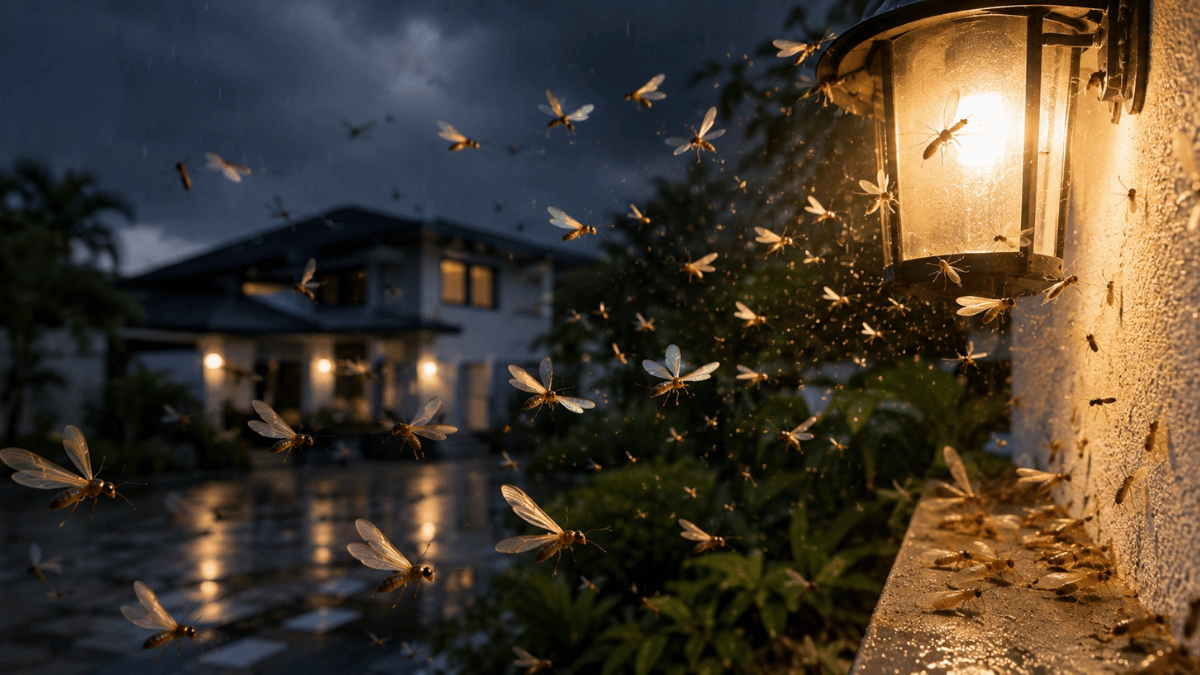
The tropical nature of the Malaysian climate means that the termites do not have the usual pattern of emerging from spring through summer witnessed in temperate regions, meaning that termites swarming season in Malaysia has its unique characteristics. Knowing when termite swarmers will emerge is very useful in identifying their presence before there is actual damage to your structure. This article will identify when this will happen.
What Termite Swarmers Actually Are
The termites called swarmers are the adults who come out of mature nests to mate and set up new colonies somewhere else. Contrary to the workers and soldiers of the termites, the swarmers have wings and are drawn to light sources and therefore can be easily seen near outside lights, street lights or windows during night time. Once the swarmer locates a good place, he drops the wings, mates and sets up a new colony, and this means that any swarmer spotted around your property will eventually cause an infestation in it.
A single mature nest can let out thousands of swarmers in one occasion, but only a very few of them are able to make it because of the reasons like exposure, predation, and drying out after some hours. In fact, this is the reason why such a large number of swarmers are released by the colonies at one time, as this is not a strategy that is concerned about efficiency but quantity.
When Do Termites Swarm in Malaysia?
Whereas in countries where spring is clearly defined, the termite swarming process is closely associated with specific months, in Malaysia, it is linked to rainfall rather than to any particular month of the year. The termites thrive in humid environments, which makes them much more active in times of rainfall, when high humidity and cool wet weather make them come out of the nest to swarm. Thus, the termite swarming period in Malaysia is often associated with the rainy season.
Why Rain Triggers Swarming
Rain moistens the soil and increases humidity, which assists in swarmers staying alive until they are able to leave the colony, mate, and build a new nest without their bodies drying up. Since monsoon rains occur throughout a number of months in Malaysia instead of during a single season, the occurrence of swarming is possible in different times of the year instead of being consistent in only one particular time. Some residents observe that swarms emerge in a repetitive fashion once there is a downpour after a certain number of days of drought, which coincides with how the colonies react to rapid changes in soil moisture.
Why Swarms Happen in the Evening
It is not unusual to find termite alates being attracted to artificial light, which explains why there are instances when swarming occurs at dusk near porch lights, streetlights, or even windows that are not covered. If you have seen swarming activities involving a lot of small flying insects in front of a light bulb right after a rainfall, then it could probably be termite alates rather than flying ants. It is through the swarming behavior of termite alates that it can be explained how these insects are able to get inside the house since they enter through the door and window cracks due to the artificial light inside.

Do Different Termite Species Swarm at Different Times?
Yet not all termites swarm in the same manner. For instance, subterranean termites are among the most common and destructive species of termites in Malaysia homes. They tend to swarm only after rainfall periods due to the fact that the air is very humid at such times. On the other hand, drywood termites do not require moisture from the soil since they are inside the timber and therefore much less predictable since they are dependent on internal factors.
Dampwood termites, despite being relatively uncommon in houses, exhibit another unique behavior, preferring to attack only rotten wood or that which remains wet throughout, for instance old fence posts, waterlogged garden buildings, or wet wood due to some constant leakage. Since their swarming is linked with very particular moisture conditions rather than general precipitation, they are the most unpredictable of all three in timing, but also the least likely to cause any harm to your home's structure.
Regional Differences Across Malaysia
The swarming behavior of the termites may also change somewhat according to the area of Malaysia the land is situated in. Areas that are coastal or low lying, which usually hold onto their humidity longer when it rains, may experience swarming somewhat more often than drier inland or higher up areas. In urban environments that have more concrete than open soil, swarms will be seen more often in the areas where the termites can make soil contact. This doesn't mean urban homes are safer, if anything, a smaller number of viable entry and nesting points can mean an existing colony is more concentrated and potentially more damaging to the specific structure it has settled near.
How to Tell Termite Swarmers Apart From Flying Ants
Because both insects fly and swarm around lights, they're frequently mistaken for one another. Termite swarmers typically have a straight, thick waist and wings of equal length, while flying ants have a pinched waist and wings of noticeably different lengths. Termite swarmers also tend to have straight, beaded antennae, compared to the bent, elbowed antennae seen on flying ants. If you're unsure which one you're looking at, our guide on spotting termite warning signs covers this distinction along with the other early indicators worth watching for.

Common Misconceptions About Termite Swarming Season
A few myths often exist regarding termite swarms, and busting them can prove useful to any homeowners dealing with the pests. The first myth is that swarming only occurs once a year, which isn’t true because a well-developed termite colony may generate more than one swarm during weeks or months in case there are favorable conditions. The second myth is that the absence of swarmers means the absence of termites in general, but in fact, there are many colonies that don’t generate swarms which would be noticed by homeowners, particularly because of its nocturnal nature, hidden location in the garden, and being devoured by birds and geckos. The last myth is that killing swarmers helps to get rid of the issue, while swarmers have already left the nest, while the colony itself causing damages stays totally safe from this activity.
What Seeing Swarmers Actually Means
Here is something important that needs clarification. Swarming is not the first step in termites’ invasion; it indicates that the infestation is already present. In order for a colony to be mature enough to develop winged reproductive termites, a few years need to pass. So if you're seeing swarmers around your property, the colony behind them has likely been established for some time already. This is exactly why swarmer sightings should prompt an inspection rather than just being brushed off as a passing nuisance, since by the time swarmers appear, some structural feeding may already be underway elsewhere on the property.
What to Do If You Spot Swarmers Near Your Home
If you notice termite swarmers around your property, a few immediate steps help limit further spread. Turn off unnecessary outdoor lights in the evening, since these attract more swarmers toward your home. Check for discarded wings on windowsills or balconies the next morning, since swarmers shed their wings shortly after landing. Avoid sweeping up swarmers or wings immediately, since inspecting the pattern and location can help a technician assess where the colony likely is. Book a proper inspection rather than waiting to see if activity continues, since the underlying colony won't disappear on its own, and swarming events can repeat over several weeks during peak conditions.
How Professionals Use Swarming Activity to Guide Inspections
For pest management technicians, any report of a swarm means something more than just a nuisance report; it's valuable information. Which way the swarming insects were coming from, the exact spot on the property where the wings were discovered, and the time of day the activity was observed can all contribute to pinpointing the general location of the colony that exists before any actual search takes place. One of the reasons why homeowners get asked very specific questions about where and when they saw the activity is because this type of information can help to locate the colony much quicker.
How Asteric Can Help
Since there isn't a definite swarm season for termites in Malaysia, the best practice would be to consider any sightings of swarmers as an investigation worthy matter regardless of the time of the year. Our termite control services start with a full inspection to locate the source colony, not just the visible swarmers, and our residential pest control services include the ongoing monitoring needed to catch new activity early, especially during periods of heavy rainfall when swarming risk is highest.