.webp)
Termites cause billions in damage every year, and most homeowners do not know they have them until it is too late. The ability to recognize termite signs in Malaysia can possibly save you money worth thousands of dollars. It is reported that termites cause damages worth $100 million annually to the owners of properties in Malaysia. The fact that they live and feed in areas that cannot be seen helps them to work silently for weeks or even years before revealing themselves. This is what you should be looking out for.

Why Malaysian Homes Are So Vulnerable to Termites
Termite colonies are best able to survive due to the tropical nature of Malaysia. The people in areas which have warm and humid climatic conditions are the ones who will be more prone to a termite infestation problem. The existence of termites might be more common in areas like Kuala Lumpur, Selangor, Penang, and Johor Bahru because the weather and environment are warm and humid in nature. This is mainly because of the presence of wood doors, wood skirting boards, and other pieces of furniture in those areas.
7 Signs of Termites in Malaysia You Shouldn't Ignore
1. Discarded Wings Near Windows and Doors
"Alates" or "flying termites" appear in Malaysia post-rainfalls or during humid evenings, and after they choose a site where they can reside, they drop their wings off. In case you see transparent wings close to the windowsills, light fixtures, or the balcony, this means that there is already a colony residing nearby.
2. Mud Tubes Along Walls or Foundations
Tubes made out of mud, wood, and saliva are created by subterranean termites which assist termites in reaching their food source from the nest which is underground. These tubes are usually the thickness of a pencil and run up walls, foundations, windows, and doors.
3. Wood That Sounds Hollow
Due to the nature of the way termites feed on wood from the inside out, knocking on the affected area will produce a hollow and papery sound rather than a solid knock on an affected beam, door frame, and skirting board.
4. Frass (Termite Droppings)
One can identify the presence of drywood termites from their pellets that resemble dust particles known as frass. The frass may be easily confused with sawdust; however, frass is more uniform and rounded than sawdust.
5. Bubbling or Peeling Paint
If paint begins to blister and peel but there doesn’t appear to be any leaking near where it’s happening, it may be because of termites’ presence below the surface, causing the moisture to bend the paint as if it were water damage. Homeowners think this is due to humidity, and it is why infestations are overlooked.
6. Doors and Windows That Suddenly Stick
Although it is tempting to attribute problems with doors not closing well to the rainy season, termites emit moisture during their feeding and digging activities, causing wood to warp and swell even in non-rainy periods.
7. Clicking Sounds From Inside the Walls
When termite soldiers bang their heads on the wood, it shows that there is danger within the colony and can sometimes be heard as a clicking sound coming from the walls of the wooden structure. This does not happen frequently, but when it does, it shows the presence of a termite colony.

Know Your Termite: Not All Species Behave the Same
There are three major kinds of termites that exist in Malaysia, which include subterranean, drywood and dampwood termites, all of which have their own unique behavior. The subterranean termite builds its nest in the ground and moves through the use of mud tunnels and is believed to be the most dangerous due to a single colony having hundreds of thousands of members. The drywood termite resides within dry wood such as wooden furniture and rafters and does not require any soil at all.
What to Do If You Spot These Signs
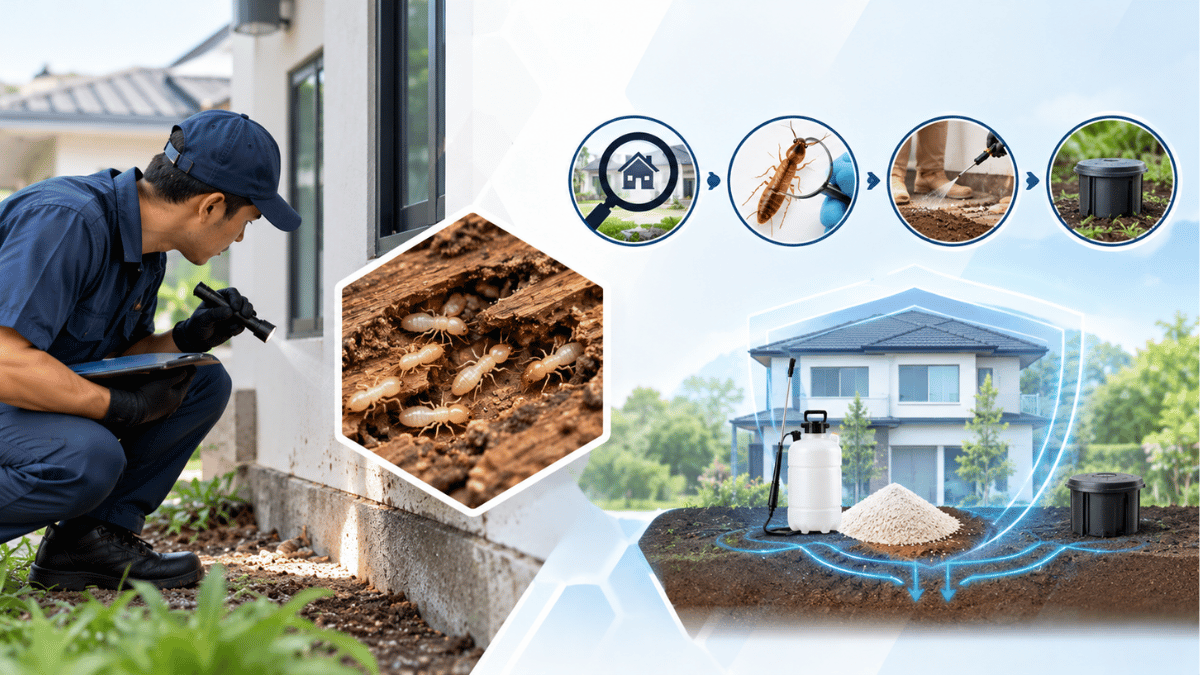
In case you can relate to any of the above, do not hesitate to take action before the evidence becomes visible from a distance away. Begin by examining the wooden portions of your home; especially the wooden frames, cupboards, skirting boards, and built-in furniture; for signs that keep coming back in many places, such as hollow wood, mud tubes, paint bubbling or wing cases. Focus on the moist areas of your home such as the bathroom and kitchen. If you'd rather skip the guesswork, our residential pest control services include a full inspection to catch what a DIY check might miss.
Why DIY Detection Isn't Enough
The identification of the symptoms might be easy, but identifying the extent to which the problem has progressed could prove to be challenging. Because of the fact that the termites are well-hidden inside the walls or any other built-in structure, it would be ideal to have an inspection conducted by a professional so that things do not get out of hand. The advantage of doing so is that one would know which specific species of termite it is and what treatment should be done.
For a deeper look at how these colonies build and engineer their nests, the Forest Research Institute Malaysia (FRIM) has published research on termite behavior and mound architecture that's worth a read for the curious homeowner.
How Asteric Can Help
Identifying the signs may not be enough. Our technicians examine the exact locations where termites hide, including wall voids, sub-floor timbers, and foundations, to identify the location of the nest and advise on what treatment is necessary for your case. This may be either baiting, soil treatment, or wood treatment.
If you're noticing any of these signs of termites in Malaysia at home, it's worth getting a proper inspection before the damage spreads further.